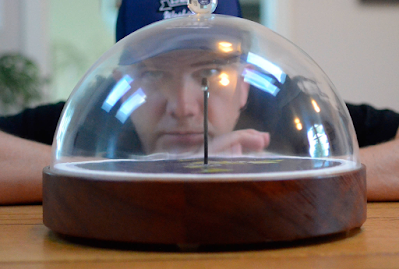
Monday, May 17, 2021

Time

 You tell me death is final night

The end of choosing wrong from right.


I ask what then if God, the One

In whose hands all the sands of time do run,

When no last rites are said, no holding hand

Stands by to wrest the sinner's prayer from dying voice -

What if He breathes upon those last few grains of sand

Provides the space, as needed, for the choice?


Must Purgat'ry at all costs be denied -

Semantics versus Lord of Earth and Sky?


For all those who now face their final night

Shall not the judge of all the world do right?


Sunday, April 04, 2021

A Memory of Magic

With my mask on and ear plugs in I am immersed in the same sense of womb-like isolation that I remember as a child: trudging up the gravel drive of an early winter morning, buckets of pig slop hanging heavy from my arms and slushing against either side of my Wellingtons, fur rimmed hood pulled over my head and zipped up completely, leaving me peering out of a warm tunnel at the darkened frosty path ahead. 

In this moment isolation has been in measure forced upon me by the strange laws of Covid on Aircraft. But I have taken ownership by adding ear plugs which completes the effect in a pleasing fashion. There are momentary and nonsensical dissonances where we the passengers remove our masks en masse to consume small packets of salty snacks and sip sparkling water. My ear plugs are likewise removed to communicate with the hostess. Then, having somehow avoided contamination during this brief period of insanity, I dive back in to the safety of my cocoon.

During one of these warm still periods, the plane gently descending over a night darkened and rain softened Seattle, I stare out at the miniature roads and houses, wondering once again at the myriad strangers represented by each light. Suddenly, from just over treetop height, a lonely junction between two roads drifts into view. Golden hooded traffic lights stand at the four corners, pillars surrounding a temple court. Dipping garlands of telephone wire enclose the space, glistening with mist. Street lights cast a hallowed glow over the scene; warm, yellow and familiar. Darkly emerald trees stand outside the crossroads, fading to black. I see the form of something archetypal stirring, but it passes before I have time to attempt a photograph. It remains clearly in my mind, where I know that a picture would have blurred and misrepresented what I saw so clearly.

Surely there is a magic when things meet: certain junctions of roads; meetings of waters, cloudy & clear; dialog between intelligences; wine & food pairings - or even the stark contrast of complimentary tastes or colors themselves. Saunas and cold plunges. The Incarnation. The wind whipping against a stationary figure high on a cliff edge. Candlelight in a darkened window. I use the word "magic" because I speak of things greater than the sum of their parts. There is a little light let in from somewhere quite other.

There are no doubt scientific rules that govern such experiences. I remember once hearing a worship leader explain that certain chord progressions led people into a desired emotive state. At the time I was offended: I thought at the time by the idea that the sacred could be engineered - as though sacred means "in defiance of natural laws". On closer inspection this explanation makes no sense whatsoever. While the word "supernatural" does suggest something that is above the laws we are normally governed by, in actual fact any such thing must necessarily be a fulfillment of these laws rather than the destroying of them.

I think perhaps what remains irksome in my memory is that a person wished to use this science to create an emotional state in others during a time of worship - when surely we should be most free from human manipulation? More than that: for this to be done to the congregation without their knowledge and free will. This in an important addition because we often deliberately go to music to have our emotions manipulated - anyone who goes to a concert would leave unsatisfied if they had not been moved during the performance. But in the case of worship there is the hope that "the anointing" just happens - a kind of magic, if you will. We don't like the idea of being manipulated - even though it stands to reason that we are being manipulated during most of our waking hours, and perhaps as a result during some of our sleeping hours also. Perhaps the best leaders of men are those who manipulate while being  unconscious of the fact that they do so? A cynic would say "while appearing unconscious".

The modern day wizards of Hollywood strive to reach this magic. Yet it is far less often attained than the existence of some kind of science behind the scenes would suggest. There are so many multi-million dollar flops. Bishop of Durham style: "all the right ingredients but nothing has risen"...  (reference: Gerald from "The Sacred Diary of Adrian Plass!) This is hard to understand. One has the idea that with enough money involved plus intention, anything is possible - but this is not apparently the case.

Once achieved, even the best of these moments is merely the whisper of something beyond; a hint of what must be the true magic. As though the wind stirred the trees and they almost spoke.

He Is Risen!

The Terror of the Grave and the Truth of the Resurrection (Bishop Robert Barron)

Sunday, January 31, 2021

I am Not Throwin' Away My Shot!

My youngest son is enamored with the musical Hamilton. He has memorized a lot of the lyrics (and has had to be helped with the navigation of some of them!). A central theme in this story is the idea of not throwing away one's shot. Alexander Hamilton, one of the founding fathers of America, starts things off by singing about his unlikely beginnings, his ambition and the fact that he is not going to throw away his shot.

Because I have heard this song both played and sung many times in the recent weeks this phrase has been turning over in my mind and may have collected some other thoughts, snowball fashion...

The premise is that we have all been given a shot - "at life", if you like, and we should use it. If we don't use it, we are like the man who is given the talent and buries it in the ground. He presents it at the resurrection and says "look, I still have exactly what you gave me - take it back and be happy with me". The response is equivalent to "I never knew you".

On the other hand what is the shot, exactly? And what should we use it on?

Firing one's shot implicitly means that one does not have it anymore. It is used up - not saved; it is not buried in the ground; it becomes marred by use, like the jacket in the fairy tale concerning the sons of the king.

Alexander Hamilton, in a duel at the end of the musical, deliberately fires upwards so as not to kill his opponent and thus looses his own life. This possibly apocryphal story ties in nicely with the theme. The ability to kill a person is not "the shot" that we must not throw away: in other words by throwing away this lead bullet Hamilton has not thrown away but rather confirmed his shot. It is true that we have this freedom, this ability to hurt others. But "our life above others" is not the investment opportunity we have been given.

There is a curious story about a man named Onan in the Bible. Because it is somewhat controversial, and used to support some controversial doctrine, many people have heard of Onan and the other protagonists in this tale: patriarch Judah and his daughter in law Tamar. The whole somewhat sordid story may be found in Genesis 38, and can be found here. I won't retell the story, but will instead comment on it.

The first thing to note is the intense important of "seed" - one's descendants, one's inheritance. Through the eyes of these ancient actors you can see that this is of primary importance. There are echoes of God's promise to Abraham: 

"When Abram was ninety-nine years old, the LORD appeared to him and said, “I am God Almighty. Walk before Me and be blameless. I will establish My covenant between Me and you, and I will multiply you exceedingly." (Genesis 17). 

And before that:

"Then the LORD said to Abram, “Leave your country, your kindred, and your father’s household, and go to the land I will show you.

I will make you into a great nation,
and I will bless you;
I will make your name great,
so that you will be a blessing.
I will bless those who bless you
and curse those who curse you;
and all the families of the earth 
will be blessed through you.” (Genesis 12)

(As an aside - looking at these two passages together you can see a transition in what God was asking of Abraham. Initially it was enough for him to be obedient to a call to adventure. But as things progress he is being asked to "walk before me and be blameless". I think of this as being the beginnings of the path "back to the garden" - away from the savagery of men's beginnings on the Earth. This proves to be a very long journey indeed.)

This theme is repeated over and over again through the Bible - the importance of one's bloodline. And over and over again there is the emphasis on the importance of having a son. This reminds me of some lines that I wrote, motivated by my reaction against a friend's disappointment when his wife gave birth to a baby girl:

For unto us a Son is Born

It is a boy! - This cry of long-awaited joy
Also describes the alternate -
Daughter; disappointment; a blank fired

O foolish ones, how slow your hearts are to believe
All that was prophesied.
For never was there but one Son,
And he already born.

No proud father here on Earth has ever known
This fulfilment, long foretold
Save Joseph - no father; almost husband; fully mystified.

Echoes of this event still
Sound and resound in our minds
But what deliverance do we look for when we thus
Desire a son, someone to carry on our line?
What long awaited hope will he
Carry us towards?

Why seek we Him among those yet unborn?
The consummation has already come.

There is now no line to be continued save for His,
And in Him all sons and daughters may find equal hope,
All families of earth be blessed.

In the story, responsibility came knocking on Onan's door: his brother dies, and now he must marry Tamar and continue his brother's line. That he must do this was clearly known to him and Tamar and to his father Judah - at a time when none of the myriad laws of the Old Testament had yet been set in stone: suggesting that it was part of an underlying canon of truth which the OT laws in part embodied. However you wish to slice this cucumber I don't think you can argue against the fact that Onan knew what he was doing was wrong and that he did it anyway.

And why did he rebel against what he ought to do? It was because he realized that he only had one shot and he did not wish to throw it away continuing his brother's bloodline.

Some people have taken this story to be a warning against masturbation or contraceptives, concluding that the intent to impregnate must never be artificially foiled. I shy away from this explanation as being overly specific and simplistic. Without arguing against such claims (I do not want to throw away my shot in this essay!) I argue that this story is all about avoided responsibility.

It is interesting to note that the bloodline which Onan refused to participate in was that of Christ Jesus.

In fact the only way we come out with more than we went in with is by giving what we have away. That is what an investment requires.

Alive and kicking today is the idea that we have more than one shot. If one views procreation as the essential thing then this conclusion naturally follows. You can see that Solomon, with his thousands of concubines and wives, could be said to have had many shots in this sense. But in reality he only had one and that one he muffed up. It could well be said of him that no man in history was ever given so many talents - whether you define this as weight of gold or ability. Initially it seemed that his investment was wise. But by means of subsequent investments, the multiplication of shot attempts if you will, he was finally left destitute.

Courtship - the winning of love and an opportunity for commitment - is one of the most exciting things on earth. And it is something that there is a longing to do more than once.

I've thought many times before about the impulse of a knight errant to rescue a damsel in distress. It is a wonderful impulse - and a couple may, in a very real sense, thus offer "salvation" to each other. There may be offered stability, friendship, pleasure, family - even a rescue from a current dragon whether that be mental, spiritual or physical. Don't get me wrong, this works both ways: there is just as much "rescuing" that happens from woman to man as the other way.

And so, on to a confession. I've been happily married for some time now, but as life goes on I've seen other "damsels in distress" and wondered what I could offer them. (The answer isn't the easily identified "one night with the King".) Stability, a new life, appreciation, happiness? Some of this impulse might be easy to see through as selfishness, an inflation of the value of what I have to offer. But the real antidote is the full truth: I do have such gifts to offer, but I may only give them once. I only have one shot. Following on, one sees that we cannot "re-offer" this gift once given, for it invalidates the gift. Let me be blunt: if I am unfaithful to my wife in order to offer faithfulness to another woman, what is the value of this "faithfulness"? This logic also applies to the other aspects. Thus, the whole imagined romance (knight & damsel, slain dragon, sunset) falls apart into a much more sordid tale, leaving a ruined family in the wake of what is now clearly a selfish intent.

Read carefully here, for I am not saying that love is not large enough to reach outside the circle of a family.

Another confusion that arises is that we have but one shot in this life for glory or fame. This equates glory with the root purpose of life, whereas it may be a byproduct can never be an end. There is a very satisfying exposition of this by Bishop Robert Barron in his talk at Google. Out of such a view comes  disappointment, a sense of failure, when one dies (or approaches death) having "only" been a good father or mother; worked to put bread on the table; worked to be fair and just in one's small dealings in one's small social group. I would argue that such a person has succeeded in not throwing away their shot, although wealth, fame and glory may not be theirs.

A life lived may lead one up to the summit of Everest, but what is important will always be how one treated the guides and fellow climbers rather than the achievement of the summit. One may arrive in positions of great power, responsibility and glory. But even in the most magnificent palace known to man only the foundational principles will remain what is important about one's life. 

Do you love your wife?
With all you've got inside you
Are you layin' down your life?
What about the others?

Are you livin' as a servant
To your sisters and your brothers?
Do you make the poor man beg you for a bone?
Do the widow and the orphan cry alone?
(Don Francisco, Steeple Song)

To those who do not throw away their shot, He will say:

"Come, you who are blessed by My Father, inherit the kingdom prepared for you from the foundation of the world."

Tuesday, November 03, 2020

Goldfish

Is it important to know the shape of where are you are living; the boundaries of your habitat? 

Does this matter as long as you can exist happily & peacefully inside? 

Is it living dishonestly to never enquire about the exact shape of your inherited society?

Photo credits: Ahmed Zayan, instagram.com/zayyerrn

I propose that all of us live inside such goldfish bowls, and that most people do not realize the true extents of these boundaries & restrictions until a crisis - an unusual internal or external force - reveals them: they bump up against the glass. At this point they have to make a decision - do they forsake it for some new boundary? Or do they own it & defend it?

We watch others thus englobed and judge their complacency. 

We are watching through the curved lenses of our our own bowls.

.
.
.
.

For the future: Commitment / Marriage / Rumspringa / Basilisk / Vocation / Citizenship / Parenthesis 


Sunday, November 01, 2020

When is it a sin to vote for a political candidate?

In the November issue of Christianity Today, someone wrote in with a response to an article from the previous issue “When is it a sin to vote for a political candidate?”:

"I believe it can be a sin to vote for certain candidates, but many Christians believe it's a sin to abstain from voting. This seems to be a cultural rather than a spiritual mandate. If there are two bad candidates, many tell me “I voted for the lesser of two evils.” If we strip that sentence to its core, it says, “I voted for evil.” "

- Elaine Creasman, Largo, Fl.

The first thing that struck me was the logical fallacy at the end. “If we strip that sentence to its core…” It sounds as though the writer were performing some algebraic manipulation, for instance:


Candidate A = Evil + Some Policies

Candidate B = Evil + Other Policies


We should be able to simplify this further, but when doing so one finds that E cancels out and we are left with what is different about the two candidates.


In other words evil is common to both. The policies are what make the difference. This is of course assuming the AMOUNT of evil is the same in each case. If A has 6(Evil) and B just has 1(Evil)? Well, once you simplify A ends up with 5E versus B who has none.


I’m being facetious here of course since I don’t believe that evil cancels out like this or can be measured objectively, save by one Person - “shall not the judge of all the earth do right?”


However more seriously the idea of a differential - more of a bad thing being worse than less - is an important concept that I do not wish to gloss over. The fact is that we all contain some evil. If we were to abstain from voting - and by extension abstain from interaction with - those who “are” evil (because they contain some evil), then we become paralyzed and cannot act inside this fallen world.


Following this particular rabbit down the rabbit-hole many Christian sects have concluded that they must separate themselves from the world - not only a separation of the heart, which all Christians (in deed, not in word only) must necessarily be on the path towards - but a physical separation. For many years of my life I was involved in such a sect, and while I still respect many of the people and their teachings I can now more clearly see some of the cul-de-sac ideology. When we separate ourselves like this there are a couple of unintended byproducts. Firstly we consider ourselves better than those outside. This can happen slowly since we start with the very Christian idea that “all have sinned and fall short of the Glory of God”. However, happen it does because we think we are the only ones DOING something about it in all of Christendom! Secondly we do not take such pains to be moral in our dealings with the “other” - considering them to be Gentiles, Babylonians, and many other such epithets drawn from the mulligan stew of our cultural heritage. Though we wouldn’t go so far as to say “happy be he who dashes their little ones against the rocks” we might consider favorably the idea of “spoiling the Egyptians”.


Here is a very practical example. In light of the recent COVID economic impact the government has issued a series of stimulus packages. These are intended to be used by those who are actually suffering from lack of business because of COVID. We’ve all seen in the news articles about companies who have grabbed for the money simply because it was there while they absolutely do not need it. It is pretty clear to us that this is wrong - the intent of this money is to provide for the needy. One would have the same reaction if the Ritz hotel was stealing potatoes from the nearby soup kitchen. But what if you believe that the whole system is corrupt, and you have separated yourself from it while waiting for the return of the Lord? You may just end up believing that this is “free money” and, no holds barred, you should grab it while it is available, and the potatoes for good measure. After all - anyone else who grabs it will be “evil” - it may as well be applied to the work of the Lord. This is perhaps a hypothetical example but cuts to the heart of the issue. Those that do such things commit fundamental moral error despite their lofty ideals.


This is a besetting sin for all those who consider the return of the Lord to be imminent. Of course on a personal level it is very important to live as though Christ were returning - 

“But suppose that servant is wicked and says to himself, 'My master is staying away a long time,' and he then begins to beat his fellow servants and to eat and drink with drunkards.” - Matthew 24, NIV

But if it is taken further you get those that run up thousands of credit card debt - because it doesn’t matter since the Apocalypse is coming before the statement balance is due. This is a fundamental moral error as it involves stealing from the bank. “I won’t have to pay it back because the Apocalypse” does not justify these actions. The reason we do not steal is not because we will have to pay it back. It is because of a moral absolute: “thou shalt not steal”.


The fact is that we were meant to be in the world and not of it. While the thought of evangelizing TikTok (November 2020 CT article) doesn’t do anything for me, I recognize and appreciate the rubric: as Christians our job is to create & provide moderating content IN the world. As C.S. Lewis said “What we want is not more little books about Christianity, but more little books by Christians on other subjects—with their Christianity latent.” (God in the Dock)


This thread leads into the question of whether or not we should be pacifist in times of war: a large & thorny subject which I do not wish to tackle fully here! In passing I will say that in cases where one recognizes the actions of our government to be fully evil it appears clear that one should abstain - witness Dietrich Bonhoeffer in WWII. However many times things are not so clear. Many German soldiers in WWI fought for God, Kaiser and country much as any American today believes he is. Yet in hindsight we say the German cause was more objectively evil than the Allies’. I personally do not feel that fighting for one’s country is wrong. But in cases where there is a draft and one feels morally compelled to be a pacifist my heart is with those who choose to be medics rather than those who will do nothing at all. That is to say - as near as I can tell from my comfortable arm chair!


Circling back to what triggered this post, I will say that in one sense I very much agree with Elaine: that is, that one needs to remain clear eyed about what one is voting for. During the lead up to this election I have heard from a lot of people who have apparently left their moral compass in the dust because they have attached so firmly to the bucking bronco of “planned parenthood” or some other issue. In no way am I saying that such issues are unimportant - in fact, they very well may be the reason one chooses to vote in a certain way despite the evil that one sees coexisting in a running platform or someone’s personal character. However - let us remain clear eyed about the whole picture. We may be able to provide some moderating content, but let us understand that God’s kingdom is not coming on earth in the form of the American government.


Christianity’s history is littered with bad examples of those who did evil in the name of God. Those who thought that the ends justify the means. To such people God will say “I never knew you”. We must retain our ability to say “thus far, but no further”. To the one side lies Scylla: here some run aground, paralyzed by the thought that they cannot effect good in this fallen world. To the other lies Charybdis - where morals are swirled away with the full commitment to a corrupt system: believing that anything is permissible in order to achieve some perceived good.


And what of those who rightly say that the ordinary citizen is not equipped with enough (correct) information to make the right choice? With fake news and disinformation on every side? All we can do is present ourselves with a clear conscience attempting to do what is right as far as we know, and trust that God will give the increase. We are responsible for what we know:

“If anyone, then, knows the good they ought to do and doesn’t do it, it is sin for them.” James 4:17, NIV

...But we must be responsible.


Thursday, October 01, 2020

Ark (Part Two)

The Palette

I would like to continue on with the idea that the universe contains absolutes, though we humans may be only partially aware of their true nature. While this may seem eminently reasonable to all and sundry, the conclusion I draw may not be!


Once we admit the absolute everything is colored by its existence.


It is futile to attempt to wriggle out from under these laws. “Can a leopard change its spots?” - an eminent sage once rhetorically asked: the fact is, we cannot.


Were we to somehow become supermen we would still be bound by these laws. If we, as supermen, appeared to break free from the constraints of men’s ordinary lives this would be because those constraints were only an incomplete understanding of the actual laws of the universe.


In an opinion piece titled “Is ethics possible without religion?” In an online column at www.malaysiakini.com Sim Kwang Yang writes: “We are all condemned to be moral agents. When we choose a course of actions, we make the decision according to whether it is morally good or bad.” This constraint comes from what I will call the “palette of colors” we possess: this is all we have with which to describe reality.


Immediately upon mentioning morals I am plunged into a greater whirlpool of opinion than I care to paddle my way through. Mores, folkways & taboos are believed by some to be simply byproducts of the religions, cultures & societies we have been steeped in. On the other hand there are quite a few “reasonable” atheists who believe that there is some kind of absolute moral truth in the universe. I mention atheists because they would seem to be the demographic most invested in denying any kind of underlying moral code in the universe, so their opinion counts here!


For my part and for the purposes of this post I am comfortable confessing that there are common elements which appear consistent (absolute) across the moral palette used worldwide. This will be our starting point - by extensional bargain: if you wish to argue we can do it elsewhere!


One beloved quote along these lines is from G.K Chesterton, in “The Innocence of Father Brown”:


The taller priest nodded his bowed head and said:


"Ah, yes, these modern infidels appeal to their reason; but who can look at those millions of worlds and not feel that there may well be wonderful universes above us where reason is utterly unreasonable?"


"No," said the other priest; "reason is always reasonable, even in the last limbo, in the lost borderland of things. I know that people charge the Church with lowering reason, but it is just the other way. Alone on earth, the Church makes reason really supreme. Alone on earth, the Church affirms that God himself is bound by reason."


The other priest raised his austere face to the spangled sky and said:


"Yet who knows if in that infinite universe--?"


"Only infinite physically," said the little priest, turning sharply in his seat, "not infinite in the sense of escaping from the laws of truth.

..."Reason and justice grip the remotest and the loneliest star. Look at those stars. Don't they look as if they were single diamonds and sapphires? Well, you can imagine any mad botany or geology you please. Think of forests of adamant with leaves of brilliants. Think the moon is a blue moon, a single elephantine sapphire. But don't fancy that all that frantic astronomy would make the smallest difference to the reason and justice of conduct. On plains of opal, under cliffs cut out of pearl, you would still find a notice-board, `Thou shalt not steal.'"


Terry Pratchett (who I will discuss more further on in this post) in his book “The Color of Magic” suggests an 8th color, octarine. This is of course the titular ‘color of magic’. I’m not in any way quarreling with his book, which among his many others I thoroughly enjoyed - it is after all fantasy and as such all sorts of strayings from the rules are permitted and even expected. But it is a good example of the limitation of which I speak: for in the book the color octarine cannot really be described despite the attempts - in the end one understands it to be (my words) a kind of purple - just one we can’t imagine. You see the problem.


(We habitually divide the spectrum of visible light into 7 colors in a fairly arbitrary way, but I am rather talking about seeing something which hasn’t been seen before: something outside our familiar spectrum.)


Similarly, in the realm of sexuality there is an increasing panoply of attempted descriptors, but they all appear to use the same limited palette. Here is a very basic list of just a few of them (I’m very probably wrong about some - not being a subject matter expert!):


  • Male: no further descriptor attempted for the purposes of this article.

  • Female: no further descriptor attempted.

  • Hermaphrodite: not found so far (as I know!) in humanity, in nature this is the functional inclusion of both female and male entities in one organism.

  • Gay: male attracted to male.

  • Lesbian: female attracted to female

  • Trans: what looks like a female / male is actually a male / female

  • Bi: male / female is attracted to male & female


The list goes on and on from here but there never seem to be more than two colors being painted with. Nowadays there is put forward the idea that there may be around 30 naturally occurring variations of chromosomes, gonads, sex hormones, or genitals. (And you have the confessing “Non Binary” who are a bit like the “Non Denominational” churches I discussed in an earlier post.) But to the casual observer these attempts have the flavor of “methinks he (it/she/they) doeth protest too much” and stray from what appears very much to be the “Intent of Nature” (ie what procreation was evolved for) - avoiding for the purpose of this paragraph the mention of any “Intent of the Creator”. 


Of course the argument could be made that any number may be represented using binary. But the underlying question would then be “why use binary to represent”?


I say all this, but there is a strong current nowadays of “thought” (I use quotes because it becomes plain on further examination that thinking is not involved) that advocates the abandon of reason and the acceptance of something else instead. There is a strange article in The Federalist about a philosopher, James Lindsay, who tweeted as a joke “2+2=4: A perspective in white, Western mathematics that marginalizes other possible values”, and about how this tweet was taken up seriously by a certain group of woke people, educators & enthusiasts. It seems that once the hammer of “racial injustice (or whatever else) must go” is in the hand, reality just becomes so many nails. I find it very hard to believe that such ideas can actually gain traction in “the real world” where corporeal children are taught in concrete classrooms - but apparently they do. Becoming mainstream is another step, but certainly “The Great Awokening” has taken many educational citadels by storm, and if the next generation imbibes too much of such royal jelly who knows what they may develop into.


You can call anything semantics and redefine things such that two plus two does indeed equal five. If one goes about this rationally (and for some good purpose?) then all well and good. But the way these people are going about it is so irrational that it becomes impossible to refute. They have cut away the very ground that any argument could be made from. Of course in time they will find this out - that they are falling (perhaps this is the legendary “bottomless pit”?) but for the present it does not seem to be a concern.


The abandon of reason is a natural consequence of the abandonment of the absolute.


Consequences

Irvin D. Yalom: “If you kill God, you must also leave the shelter of his temple”


Suzanna Clarke: “The Beauty of the House is immeasurable; its Kindness infinite.”


Friedrich Nietzsche: "Who gave us the sponge to wipe away the entire horizon?"


Men appear to have a blind spot - an inability to understand the true consequence of their actions. I am talking here about supposed experts, men who should know better: scientists, philosophers, bankers, craftsmen… I also speak for myself! Writing is a way in which we attempt to be objective - but in life we are all subjects.


Take the financial crash of 2008 for example - a summary from Wikipedia reads “Excessive risk-taking by banks combined with the bursting of the United States housing bubble caused the values of securities tied to U.S. real estate to plummet, damaging financial institutions globally, culminating with the bankruptcy of Lehman Brothers on September 15, 2008, and an international banking crisis.” I listened to an analysis of the actions which led up to this event - hindsight is of course if not 20/20 at least better than real time sight! I’m fascinated by the idea that subject matter experts - whose knowledge and intelligence far surpass mine - were unable to see that the actions they were taking would end in financial ruin. True - there were a few analysts who saw it coming and even warned of the coming doom. But the fact that they were not listened to is telling. Of course we know that sometimes greed outstrips reason: the golden goose has been killed more than once in mankind's history. But by and large in the interest of self, humanity (especially the Epicurean & educated elite) has learned this lesson and tends to self limit: they understand that “goose dead” equals “no more gold”. It is the fact that this equation (ie, consequence) is hidden that leads to Anatidaecide.


Another example is Brexit. It appears that this idea was suggested in the first place for fairly simple reasons, but lurking beneath the surface was a leviathan of complication. Over time many have been strongly in favor and many strongly against, divided for the main part along partisan lines - but neither side seemed to know what it would really mean if implemented; how it would really work in practice. There were hints and allegations thrown both ways of course. I won’t dive into this subject further because it is so complex, and even now being worked out in practice. My point is simply that it hasn’t been simple to have a truly educated opinion about it.


I have watched a few videos on YouTube where people claim to have created / invented machines with perpetual motion - generating energy from nothing. What appears to be happening here is self delusion by means of artificially complicating a mechanism to the point where it is no longer clear that the input is connected to the output. At this point, and observed via a number of false measurement systems (as my physics teacher would say “What are the units? Sausages?”) it is easy to imagine that some magic is happening between the input and the output and - voila! - we have ourselves a free lunch.


This matter of obscuring the connection between input and output is, after all, how all magicians work their craft. Penn & Teller’s job is to penetrate the obscurity - which they do rather well.


The current Conaviris situation is another instance. Global Warming is another. Who the next president should be is another. These are all systems of belief that are complicated enough that it is difficult to “prove” some thesis about them: in other words there is room enough for doubt such that subject matter experts disagree wildly about facts and predictions. These are not simple physics problems - “if ball A is hit by a force of B newtons in a direction of…” (Side note: however, refer back to the article about 2+2=4 above!) You will find people on both sides of the fence who will tell you with assurance “of course global warming (or, insert other example) is (true / false / serious / completely laughable). Look at x, y and z.” Their assurance is laudable I am sure, but the experts cannot all be right since they contradict each other. 


After some time has passed analysts will look back at these bumps in the road and opine about what exactly made them tick. They will mostly get it right if their intent is honest.


If God exists he has similarly not chosen to show himself in a simplistically provable way. There are necessary reasons for this in my opinion which I don’t wish to go into in this post. But there is the promise - threat? - of a coming day when “every knee shall bow, every tongue confess”. The obscurity will be made plain. This does not presuppose that all will be delighted with the final proof.


In the book "Nietzsche Wept" by Irvin Yalom (which I greatly enjoyed; the author attempts to put himself in both Nietzsche's shoes and those of his (fictional) therapist) Yalom has Nietzsche say "If you kill God, you must also leave the shelter of his temple". I admire the way that Yalom has distilled into this pithy sentence the spirit of what Nietzsche (himself the master of aphorisms!) appears to have believed - perhaps again here, fiction is clearer than reality? Nietzsche understood that the temple was a product of the god: that when the baby went the bathwater should be thrown out also. Others have seemed to think that humanity's boat could now proceed as always - only more peacefully without this irritating God, constantly wanting to get his oar in. Nietzsche on the other hand appeared to understand that we were up the creek without a paddle and possibly also without a canoe. “Despair is the price one pays for self-awareness” his fictional version aphorizes - and his real self writes of a similarly balanced equation:

What if pleasure and displeasure were so tied together that whoever wanted to have as much as possible of one must also have as much as possible of the other — that whoever wanted to learn to “jubilate up to the heavens” would also have to be prepared for “depression unto death”? (Friedrich Nietzsche, "The Gay Science")

Whither are we moving? Away from all suns? Are we not plunging continually? Backward, sideward, forward, in all directions? Is there still any up or down? Are we not straying, as through an infinite nothing? Do we not feel the breath of empty space? (Friedrich Nietzsche, The Parable of the Madman) 

In practice, a temple may be used for many generations after the exorcism of the god; the bathwater may be used for subsequent children, though it becomes certifiably more dingy with the progress of time. All Nietzsche was pointing out is that it is not truly honest to do so. I admire his thoroughness but question his retention of the virtue called honesty: it smacks of incense and soap.


Nietzsche’s death is often used as an object lesson by those who disagreed with his philosophy. I wish to avoid this since even those who do not want to make a religious or moral object lesson out of him cannot agree about what caused his death. (As he himself said “there are no facts, only interpretations.”!) It appears fairly clear that his life, however, was one of some torment. I believe he viewed this as a necessary toll on the journey to a greater goo... - no, of course not: a greater... Man. The hope being I think that we humans are larvae, and only need a kick in the right direction to metamorphose into our true form - the superman. I love this idea - having often wished for a radioactive spider or industrial accident to supply what I personally feel the lack of. “All the days of my appointed time will I wait, till my change come.” (Job 14:14)


Some of the greatest mistakes made are wrong turning on the road to truth. I believe the acceptance of despair as the price for truth is in itself a lie. That this juxtaposition of truth and despair was borne out empirically in Nietzsche's life is no proof of the pudding. But I would suggest that truth known without knowing the person who is truth may perhaps indeed be the road to despair. It is a wrong question; it is the illicit grasping of the fruit of the tree of the knowledge of good & evil:


Come in by the gold gates or not at all
Take of my fruit for others or forbear, 
For those who steal or those who climb my wall 
Shall find their heart’s desire and find despair.

...

There, only a few yards away from him, stood the Witch. She was just throwing away the core of an apple which she had eaten. The juice was darker than you would expect and had made a horrid stain round her mouth. Digory guessed at once that she must have climbed in over the wall. And he began to see that there might be some sense in that last line about getting your heart’s desire and getting despair along with it. For the Witch looked stronger and prouder than ever, and even, in a way, triumphant; but her face was deadly white, white as salt. ("The Magician's Nephew", C.S. Lewis)

Note that it is not that truth, or the knowledge of good, or the discernment of evil, are wrong things to want, to have & to hold. But there is a route & intent (route & intent are closely tied together) which is wrong. The path to Eden is not obvious.

Gratitude & Worship

Any man that stands surrounded by nature in all its glory - magnificent fall colors gilding the hillsides; the infinite blackness of space impacted by the light of distant galaxies; unimaginable power and beauty in the curled fist of a wave - and feels thankfulness has already let something past his guard, though he knows not what. My belief is that such thankfulness is the thin end of a wedge sufficient to let in the Creator.


G.K. Chesterton says “The crux and crisis is that man found it natural to worship; even natural to worship unnatural things. The posture of the idol might be stiff and strange; but the gesture of the worshipper was generous and beautiful. He not only felt freer when he bent; he actually felt taller when he bowed. Henceforth anything that took away the gesture of worship would stunt and even maim him for ever. Henceforth being merely secular would be a servitude and an inhibition. If man cannot pray he is gagged; if he cannot kneel he is in irons.” (The Everlasting Man, G.K.Chesterton).


This is my Father’s World

“This is My Father’s World” is a hymn which expresses much of what I am trying to convey here. There are some lines which come back to me again and again - “I rest me in the thought”; “He speaks to me everywhere”; “O let me ne'er forget / That though the wrong seems oft so strong, / God is the Ruler yet.”


The fact is that the Ark, the Absolute, the Temple - is all but impossible to abandon completely despite the best attempts of humanity. “He speaks to me everywhere.” As it says elsewhere: “The heavens declare…”


One example that I find somewhat amusing is the “Dark Materials” series by Philip Pullman. This was intended to be an antidote for what Philip saw as the poison of Christianity; a rebuttal to the false postulates of Narnia. Indeed, as one reads it there is plenty that could be quite offensive. The church (though it is perhaps more the Catholic church that is targeted - Protestants all may breathe a sign of relief!) is set up as the enemy of all that is reasonable & good. God himself is a weakling figure, dying out and pitiable. However throughout the series (which I really enjoyed - it is a rollicking story and well written to boot) Philip has completely failed to avoid the theme of good & evil. He has, to be sure, painted everything with opposite colors (“Opposite day!” - as my 8 year old son loves to proclaim). But - his palette is limited to that which we all know innately: good vs evil. Justice triumphing eventually over injustice. Two plus two does after all turn out to be four. There has been a magnificent creative struggle, but no new colors have been created. “Names have been changed to protect the innocent” - but when all is said and done the triumphant line rings out “This IS my Father’s World”. It is inescapable, and if we are ignorant we are willingly ignorant.


I don't completely endorse Mr. Pullman's works as harmless. He takes deliberate aim at many things which I hold to be sacred, and the fact that he does not succeed overall does not mean he does not succeed at all. Not wishing this to be a book review, I will simply point out that you cannot relax into his world as you would into a story by someone you trusted completely.


I do sympathize with Philip and others like him. Many of the things he attempts to tear down in his books are accurate representations of the many horrors the church has indeed perpetrated through the ages. But what remains unnoticed and appears unknown by these men is the fact that:


“I and he are of such different kinds that no service which is vile can be done to me,

and none which is not vile can be done to him.”

(The Last Battle, C.S. Lewis).


Terry Pratchett is a favorite author of mine who is a good example of what I am talking about. I enjoyed the posthumous article about him penned by his friend Neil Gaiman titled 'Terry Pratchett isn’t jolly. He’s angry'. I couldn’t agree more. Some of my favorites volumes in the series involve Samuel Vimes, a scrappy individual who rises from the self immolation of alcoholism to head what passes for a police force in Ankh-Morpork (the greatest of the cities of the Discworld). Sam is a heroic figure, standing up despite his human frailty against “what's wrong with the world”. Terry was also an atheist, but in my opinion very much failed to “leave the shelter of His temple”. 


Many of Terry’s most beloved & iconic characters are witches. He is obviously aware of the various injustices against them through history - Salem perhaps most famously but also the general persecution of older single women living alone with their cats, based on the biblical “Thou shalt not suffer a witch to live.” But in Terry’s books he is not claiming that evil witches are heroic: instead, they are reinterpreted as midwives, sages in herbal lore, self confident and self assured, with some magic thrown in for good measure - and are always standing up against evil when it rears its ugly head. You might say (as people have similarly claimed regarding the records of Mr. Potter’s career) that this will teach our children to love witches; witches are evil; therefore our kids will love evil. I don’t believe this for a moment. Instead I would say the object lesson might be rather “how to recognize, and fight against, bullies”. I would not love Terry’s work if he had actually succeeded in writing books where evil was heroic and triumphant: where cowardice was magnified and injustice praised.


There are a whole string of such folk - Richard Dawkins for instance - who rail against the injustice of God and the moral transgressions of the church, while failing to see that they are judging these institutions while standing on the foundation on which they are laid. “This IS my Father’s world”. Yes: there is much to judge and there will be little mercy for those who build perversions on such a foundation. But if we step off the foundation we may not judge at all; everything becomes relative.


If then there is an absolute, and if we are all born able to some extent to recognize it - that is, via some small part of it which is integrated in us - this changes everything. “...the truth is that if you once experience this - put your hand just once on the alien surface of The Artifact - a complete inversion, a turning inside out, of your understanding will assuredly take place…”


There are hints of this through the history of humanity. Every society has either been feeling after or deliberately turning their backs on this... something. St. Paul understands this when he speaks to the Greeks on Areopagus:


“The God who made the world and everything in it is the Lord of heaven and earth and does not live in temples built by human hands. And he is not served by human hands, as if he needed anything. Rather, he himself gives everyone life and breath and everything else. From one man he made all the nations, that they should inhabit the whole earth; and he marked out their appointed times in history and the boundaries of their lands. God did this so that they would seek him and perhaps reach out for him and find him, though he is not far from any one of us. ‘For in him we live and move and have our being.’ b As some of your own poets have said, ‘We are his offspring.’ c

(Acts 17, NIV)

b From the Cretan philosopher Epimenides

c From the Cilician Stoic philosopher Aratus


In other words Paul isn’t sharing something new, but rather pointing towards something that has been hinted at all along. He says “you are ignorant of the very thing you worship—and this is what I am going to proclaim to you”. There is of course a difference (of responsibility, but also of quality) when you know what and whom you worship, but even without knowledge worship can take place. As in the case of the person who, awed by the beauty of nature, is thankful. And in the case where any person (they do not have to be a Christian!) chooses to do something they know to be good.


Myth & Reality

This was the crux of what Tolkien, Lewis and Dyson were talking about during that famous walk in Addison’s way: the fact that all myth points towards a definite end - rolling towards some overwhelming question… Lewis at that point in his life was of the opinion that myth was “lies - breathed through silver” yet lies nonetheless. In his poem “Mythopoeia” (written just after and inspired by this conversation) Tolkien writes:


“I would with the beleaguered fools be told,

that keep an inner fastness where their gold,

impure and scanty, yet they loyally bring

to mint in image blurred of distant king,

or in fantastic banners weave the sheen

heraldic emblems of a lord unseen.”


For Lewis, coming to an understanding that all myth has hints of truth in it (“image blurred of distant king”) and that Christ was the one true myth - the absolute incarnate - the myriad puzzle pieces he already had in hand finally clicked together. His hand touched the Ark: recognition.


G.K. Chesterton writes more on this theme, and much better than I - for those interested I would very much recommend reading “The Everlasting Man”.


“Blessed are the men of Noah's race that build

their little arks, though frail and poorly filled,

and steer through winds contrary towards a wraith,

a rumour of a harbour guessed by faith.”

(Mythopoeia, J R R Tolkien)


Thursday, September 10, 2020

Ark (Part One)


4kwpMtdonR7gVQra4RCMcZ1KEMjqR5itiJLSNr26XsQvy9ZFmotdnVnQMOEPuZdlqJr_76fBvCz8IQciNEn0XSa8bNB_Pnwc2_mNsi48_dRZcUntfdG-MSHCQlS9Dl5iqZ-CoBQF
Old English ærc, from Latin arca ‘chest’.


The Hebrew word for ark is “TEVAH“=תבה - “perhaps of foreign derivation”. This word is only used twice in the Bible and apparently means both “ark” (which in turn means some kind of box or container) and “word”. Here is an interesting source for this, also here and here. (Subnote: at what point does a word cease to be of foreign derivation and become naturalized? After all the story of the Ark is by definition one of the “root” stories of the Hebrews - of the world…)

“By having thus read the books of the Platonists, and having been taught by them to search for the incorporeal Truth, I saw how thy invisible things are understood through the things that are made. And, even when I was thrown back, I still sensed what it was that the dullness of my soul would not allow me to contemplate. I was assured that thou wast, and wast infinite, though not diffused in finite space or infinity; that thou truly art, who art ever the same, varying neither in part nor motion; and that all things are from thee, as is proved by this sure cause alone: that they exist.” (St. Augustine, Confessions Chapter XX)
 
“In my youth I thought archeology was but a quest for the ark. In middle age I scorned such childish notions. Now that I am old enough to know better, I begin again to wonder…” (Anon.)

In this life one learns not to place one's full weight on any single source: to do so were to prove it could not carry the full weight of truth. Yet we may perhaps cross the abyss leaping lightly from one to the next and so on - for each contains enough substance to provide some support.


The Archaeologist

My premise in this essay is that we humans live our lives as archaeologists, forever sifting through our contextual sands in search of evidence.

The fact that men do search does not seem to be in question. It is a point of pride among us. But what exactly are we looking for? This basic ignorance underlies each question that has been asked throughout the ages: by scientists and debunkers; by poets and sages; by that piece of us that longs and seeks - though often smothered and sometimes extinguished by our choices and the exigencies of life.

It has been reasoned that since we seek there must be something to be found. As thirst implies water. But it appears that the object of some such treasure seekers is to prove that there is no treasure: that the trove of found objects through the ages is but mere happenstance - as the bones of dinosaurs are viewed: excretions of the same blind and inchoate chance that thrust us into the world. Can chance produce such instances of fear and wonder? Are we just a peak in the waveform of white noise which describes the universe as we know it? Or is there music being played; the strains of which our wandering ears catch, and we struggle to place the intricate and half-remembered melody.

When I imagine the archeological dig of my premise I am seeing a landscape such as one might find in science fiction - in Egypt perhaps. There are hints of Stargate (or at least the archetype that Stargate struggles to incarnate). A hot wind blowing; a sandy pit; a blackened but definitely metallic substructure being uncovered - I call this The Artifact. It is thickly engraved with winged beings and archaic symbols. Touching it, there is that sense of incredible mass one gets when exploring a cave and a sudden awareness breaks in of the vast column of rock uneasily resting only inches above our head, pressing down inexorably. The Artifact is harder than any substance we have yet known. What little we see appears to be the creation of some alien intelligence; yet the more sand we push away the more we sense that The Artifact, far from being a solitary trace of this civilization, appears to underpin all of our current reality. Unpleasant, somewhat unsettling thoughts arise from this discovery. Yes, there may be excitement - but dread is perhaps more natural: we would rather it was not so. There is a sense in which the equations of our neatly calculated world have fallen apart, shattered by the impact of this discovery. And of course the winds are always blowing, the sands always collapsing in and around our excavation: making the most solid thing in the universe once glimpsed seem without substance, a mirage veiled behind the trickling ribbons of sand. I have a certain sympathy at this point with the believers of the flat earth theory. There is something woefully handmade and half finished about their domed models of the universe: as if we lived in a science fair project. We bat our wings against the glass but cannot escape. We long for the purity of unsullied chance - for the far reaches of an infinitely expanding possibility where no-one meddles in our affairs. And how we fear the contrary! 

B7kWHQyHElPvutdnoZS3aFeJ-akDAaI9iuO3dVz0uPVnllqob8hFfmtwrkTqF9Hsb-o-qsrxoS9_dT7nRJtWPgnN1A2J88aAPFa9zISeZWzgQNqLxzV0N0sukI9uCfohO5F6279A=w399-h269

(Mark Sargent views a model of the Flat Earth)

(Truth is that either way we have largely been left free, left to our own limited devices - by lizard men and Gods alike.)

The discoveries thus made, being of the intangible type, resist being pinned to cork boards, categorized and boxed for future examination, or put on display under glass - nested and warmed by the measured lamps of scientific enquiry. But humankind has, as long as history has been recorded, attempted to preserve these discoveries. They are hinted at in ancient writings; boldly affirmed in dogmatic doctrines; fragments are cried aloud on street corners; harsh whispered in secret incantations known only to the initiate; scattered in myriad dead sea scrolls, papyrus pamphlets, intractable tracts, tomes of intolerable weight: leaflets scattered out like starlings into the world. Who shall believe our report? For there are so many reports, and none quite agree.

In fact our search (on whom the ending of the age has come) often has such regurgitated evidence as its subject matter rather than the object itself - such is our fundamental need to build on the shoulders of those who have gone before: the subject matter being too large for any one man to grasp. So there is built up a Kowloon Walled City of evidence over time, with the kind of complexity which limits a man to be an expert in only one field: the impossibility of holistic knowledge absolutely decreeing imbalances of one sort or another in everyone’s understanding.

I should mention in passing that in all of human history there has been just one such man: who did not stand on men’s shoulders but in the source itself. At the age of twelve he already baffled the sages of his time with his understanding of what they had spent their whole lives studying. “The Lord of the Sabbath is here.”

It is interesting to find, as I leaf through some of the evidence uncovered and recorded by those long gone (Plato, St Augustine and others of their ilk), a strong impression that these men lived and discovered and died mere days ago. Their writings are not ancient, dried up and difficult to understand as I feared they would be when I first began to read. There is an immediacy to their discourse and understanding - a very real sense in which for all our champing at the bit and straining at the harness we have not pulled the cart of understanding any further down the road - even though we have this idea in our modern world of being somehow at the forefront of a long proud history of pioneers, mystics, scientists, engineers, poets and so on: all steadfastly marching onwards. Is it disheartening to realise that in some absolute sense we are making “absolutely” no progress?

For progress must be measured with reference to something. And against what do we measure our own?

In the book “A Canticle for Leibowitz” (Walter M. Miller) there is a theme in which religion functions as an ark. Civilizations rise and then collapse into dark ages, eventually to rise again in new peaks which are likewise fated to fall. Through each dark age, monastic communities carry mankind’s store of knowledge through each flood of darkness: science is sheltered by the arcana of religion. This story is a both a description of humanity’s past and a prophecy of its future based on some empirical understanding of the way reality works rather than (from what I can tell) a belief in the Catholic religion itself. An ark will still work whether or not you believe that divine providence inspired the making of it. But without such belief you are unlikely to end up on the inside. (Am I missing the point of the author here? If so I am missing it deliberately.)

Thus, civilizations rise and fall - but outside the turmoil of these terrible waters the adamant truth lies like alien treasure, besetting us before and behind; the walls of an ark which provide shelter but only for those who choose it as shelter. 
“Behold, I am laying in Zion a stone of stumbling, and a rock of offense; and whoever believes in him will not be put to shame.” (Rom 9:33)

Wonko the Sane

In Douglas Adam’s marvelous book “So Long and Thanks for all the Fish” we read of Wonko the Sane who, convinced the world was crazy, built an asylum to put it in - the outside of which was his house:
“Here,” said Wonko the Sane, “we are outside the Asylum.” He pointed again at the rough brickwork, the pointing, and the gutters. “Go through that door” — he pointed at the first door through which they had originally entered — “and you go into the Asylum. I’ve tried to decorate it nicely to keep the inmates happy, but there’s very little one can do. I never go in there myself. If I ever am tempted, which these days I rarely am, I simply look at the sign written over the door and I shy away.”  (So Long & Thanks for all the Fish, Douglas Adams)

I’m including this reference because it came to mind when thinking through this Ark idea: the concept that the Ark - The Artifact - is actually larger and more real than the seas it defends us from. It is an inside-out idea, like Wonko’s.
“Underneath are the everlasting arms” (Deuteronomy 33:27)


The Venn Diagram

Believers - various shades of Christian as well as those from other faiths - often have this way of looking at themselves as separate from the rest of the world. This becomes logically problematic since an impossible Venn Diagram springs up: a central circle titled “Truth” together with countless little circles floating around each claiming the relationship “Of the Truth, but NOT of this world” where “this world” is defined by being “anything other than this bubble” and therefore attempts to exclude all the other little bubbles. If you put this into practice it will immediately become clear that in order for it to be logically true each small bubble must only contain a part of the central truth. The impossibility arises from each sub-bubble's claim to contain MORE than just a part - and indeed to deny that the other bubbles contain truth at all.
“That which was from the beginning, which we have heard, which we have seen with our eyes, which we have looked upon, and our hands have handled, of the Word of life” (1 John 1:1)
“Whom therefore ye ignorantly worship, him declare I unto you.” (Acts 17:23)
However silly this imaginary Venn Diagram may be, the truth is that if you once experience this - put your hand just once on the alien surface of The Artifact - a complete inversion, a turning inside out, of your understanding will assuredly take place, somewhat like the moment I referred to previously of exploring a cave when a sudden comprehension of gravity comes crashing in. Your understanding of “the world as I see it” - a carefully curated model built up lovingly through the impressionable years of childhood; poorly spring cleaned by the shallow doubts of adolescence; furnished & made habitable by the physical necessities and cognitive biases of middle age - is blown apart. You become convinced that this life as we see it is just the tip of the iceberg and that “the real thing” is ever so much larger and more real and more important.
“Of the Rock that begat you you are unmindful, and have forgotten God that formed you." (Deut 32:18)
We appear to do two things after any such revelation. The first is to judge others that appear not to have experienced the truth we have seen. The second is to forget. Perhaps the reason for the first is that we fear the second? The clarity of understanding has a half life, as each ark has had through history. Noah emerges and gets drunk. Moses, deliverer of nations, rises and falls through his history as each subsequent touch carries him forward - his face luminous - and then recedes. We see clearly, then look away and forget. 
Monasteries form and then become only form. Luther makes his heroic stand: he can do no other - but ends his life doing that other which he once knew to be wrong. (For completeness, a sub-part of "thing one" would be an attempt to proselytize. Judgement may be suspended until this fails!) A friend suggested:
I think this stems from our natural in-built fight for dominance. In lesser species would-be-dominant males fight to the death. 
I'd like to think that this is the very antithesis of true Christianity. But didn't Jesus himself level judgement on those who didn't agree with or acknowledge him? 
And, besides, in any walk one has to muster sufficient enthusiasm to carry out any notable task - you have to believe in yourself. And if others stand in your way it means a fight, even if the fight is an internal struggle.
I agree with much of this, but feel compelled to comment on the figure of Jesus as mentioned here because it ties into the central point of this essay. Far from being one who fought for a half remembered revelation (and perhaps fought BECAUSE it was half remembered!), he WAS the revelation, incarnate. He was - and is - of the very substance of this alien artifact. 

Ultimate reality brings ultimate judgement.

The Elephant

I am reminded of the parable of the blind men and the elephant. In this, each man was able to describe only what they could grasp of the elephant, reporting wildly different aspects and arguing that each alone had the truth of it.

In our most truthful moments we may admit to each other that we are as blind men: let us also be assured that there is an elephant in the room.